
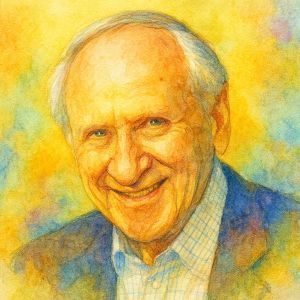
 Journalist, language legend, and presidential speechwriter
William Lewis Safire (1929–2009) was born on this day in New York City.
From a young age, he was exposed to his neighborhood’s blend of languages —
Italian, Yiddish, Chinese, and more.
Journalist, language legend, and presidential speechwriter
William Lewis Safire (1929–2009) was born on this day in New York City.
From a young age, he was exposed to his neighborhood’s blend of languages —
Italian, Yiddish, Chinese, and more.
“Good writing is the transmission of original ideas,” he said.
Beginning in 1968, he was then-President Richard Nixon’s “absolutely trustworthy” speechwriter for five years, partial to alliteration (“nattering nabobs of negativism”), but always a genius with words.
“Is sloppiness in speech caused by ignorance or apathy?” he asked. “I don’t know and I don’t care.”
In 1973, he joined The New York Times as a political columnist and snagged the coveted Pulitzer Prize in 1978. “Thoughtful troublemaking is good,” he said.
For 30 years, from 1979 until his death, Safire wrote the On Language column — over 1,300 installments — in The New York Times Magazine. A celebration of dry humor and cleverness, the popular column demonstrated his writing skill and flair, respecting language enough not to simplify it.
Calling himself a “libertarian conservative,” he was respected by both conservatives and liberals, published four novels, and became a familiar on-air pundit. He once said, “Only in grammar can you be more than perfect,” reminding us to question the detail, not the idea.
 Nothing is “obvious.” 💥