
~ Benedict de Spinoza
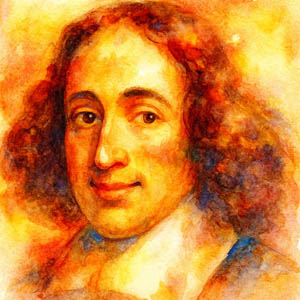 Called “the noblest and most lovable” by Bertrand Russell,
philosopher Benedict (Baruch) de Spinoza (1632–1677) was born on this day in Amsterdam.
His given name, Baruch, is Hebrew for “blessed.”
Called “the noblest and most lovable” by Bertrand Russell,
philosopher Benedict (Baruch) de Spinoza (1632–1677) was born on this day in Amsterdam.
His given name, Baruch, is Hebrew for “blessed.”
“Desire is the very essence of man,” he wrote.
An Orthodox Jew of Portuguese-Jewish descent, Spinoza was excommunicated in 1656 for openly questioning the Talmud, the heart of Jewish law. “Do not weep; do not wax indignant. Understand,” he said.
Convinced that politics and religion should not mix, he developed the philosophy of Pantheism, seeing God in everything. “The wise man does not meditate on death,” he said, “but on how to live.”
Influenced by Hobbes and Descartes, Spinoza believed in the power of knowledge, that thought and matter are the basic categories of reality. His arguments often followed the logic of geometric proofs.
His major work, Ethics, was published after his death, written in geometrical order modeled after Euclid’s Elements. His careful examination of the state of Nature influenced Kant, Freud, and countless others.
“We feel and know that we are eternal,” said the philosopher who made his living grinding lenses for spectacles and telescopes.
For Spinoza, God was “the creative, absolutely perfect power of the Universe.” He believed individuals were free to question, and that all of Nature was one, every part of the Universe connected and alive within God. His rational philosophy opened the door to the Enlightenment and modern Biblical criticism.
“Happiness, pure happiness, is a virtue in itself,” he said and trusted that joy was part of our nature.
 Look for the divine spark everywhere.✨