
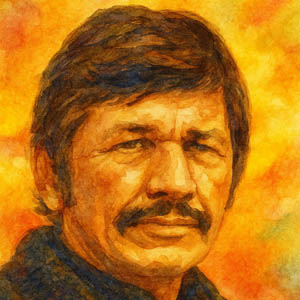
 Born Casimir Buchinsky (1921–2003) in the coal-mining town of Ehrenfeld, Pennsylvania,
hero-at-heart Charles Bronson grew up in deep poverty as one of 15
children. The son of a Lithuanian immigrant miner, he later joked,
“I guess I look like a rock quarry that someone has dynamited.”
Born Casimir Buchinsky (1921–2003) in the coal-mining town of Ehrenfeld, Pennsylvania,
hero-at-heart Charles Bronson grew up in deep poverty as one of 15
children. The son of a Lithuanian immigrant miner, he later joked,
“I guess I look like a rock quarry that someone has dynamited.”
A World War II Army tail gunner, he changed his name to Bronson in 1954 and earned his first major role in Machine Gun Kelly (1958). Soon after came unforgettable turns in The Magnificent Seven (1960), The Great Escape (1963), and The Dirty Dozen (1967).
“I supply a presence,” he once said — and he did. Director Charles Laughton praised his “strongest face in the business,” a presence that spoke louder than dialogue.
His mythic role in Sergio Leone’s Once Upon a Time in the West (1969) cemented his reputation. In 1971, Bronson received a Golden Globe as “the most popular actor in the world,” carried by an international fanbase drawn to his quiet strength.
A gifted painter who raised horses, Bronson also starred in the controversial but culturally lasting Death Wish (1974). He defended its premise carefully, saying he believed audiences responded to the emotional truth of wanting protection, not imitation.
Producer Frank Konigsberg summed up his appeal: “He has a mythic American quality that somehow shines through. He’s a working-class hero.”
Bronson’s path show how strength isn’t always loud. His resilience grew from early hardship and a quiet wish to rise, a steadiness shaped by the places he came from. Beneath the tough roles lived a man whose light didn’t blaze outward so much as steady the space around him.
 Stand tall. The world needs your original spark. 🌟